
A version of this content was originally presented by Alissa Renz at Slack Dev Day 2026.
When we talk about building for AI, the first thing we often think about is its promise and its capacity to delight. The Slack platform provides a uniquely perfect place for that, and we are all understandably excited to integrate agents with the apps we deliver to users.
As developers and builders, we are working on the edge of possibility and the forefront of the future. We are building apps that can interact with people’s lives and workflows in new ways with new possibilities. It brings us joy and of course we want to share this joy with our users.
However, the joy won’t last if your app isn’t built on a foundation of trust. This is even more so when you’re building with agents. Trust is the fundamental prerequisite for successful agent adoption. Without it, users won’t interact with your agent, or worse, will abandon your app.
Most users have expectations that agentic apps are trustworthy, which is heavily influenced by their conversational nature. Because of this, any errors or deviations from expected behavior are more jarring, more confusing, more frustrating, and more impactful. When your agent doesn’t act as expected or needed, it can affect how much users trust your app and whether or not they are likely to abandon it or adopt it.
When trust is firmly established, users are more likely to reach for your agent whenever the opportunity arises. They will add it as an integration or find it in the Slack Marketplace, integrating it into their daily workflows. Building a positive experience will garner positive sentiment about the agent – and, by extension, your app – each and every time that they interact with it.
So how do you design for trust on the Slack platform?
If you’ve read our series on building for the Slack Marketplace, you’re already ahead of the game. The principles that govern creating a great app for the Slack Marketplace are also the same ones you’ll use with building an agentic app. But to summarize, every agentic app requires four things: predictability, transparency, control, and safety.
Building a predictable framework around a non-deterministic tool is the first step.
By offering an agentic app, you’re providing a new way for users to interact with the world. In the past, a simple, button-based UI that failed was irritating, but not always a dealbreaker. Apps were less interactive and much more impersonal. When they didn’t work, it wouldn’t necessarily damage the user’s trust. However, when an agentic app fails to deliver or gives an unexpected prompt or hallucination, trust is easily broken.
This is why predictability comes first when designing an app. Give deterministic outputs whenever possible and give your agent guardrails. Use permission scopes and least privilege design and build with those guardrails in mind. Respond to events reliably and acknowledge them quickly. Use tools like the Slack Events API to help your app communicate effectively with your user. Tools like Slack’s MCP Server also help make your app predictable by delivering the right tool, data, or service in a standard and consistent way.
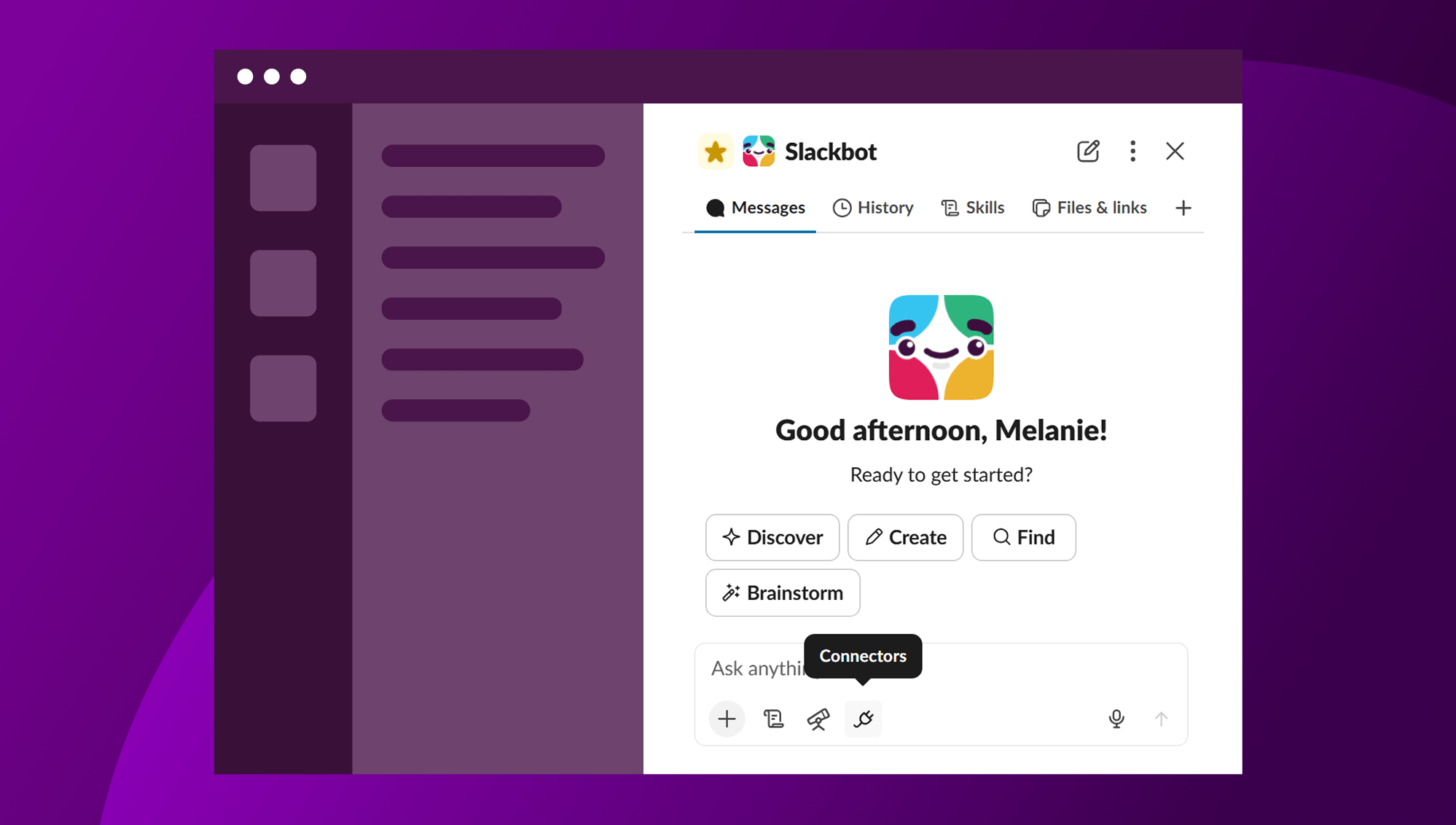
When you are designing your app for predictability, also work to build trust through transparency. Your app shouldn’t be a black box that spits out magic answers. Instead, make sure every action taken and decision made is accessible to the user. They should be able to easily tell what the app does, when it does what it does, and why it does what it does. Slack provides a thinking steps feature in Block Kit to show users what the agent is doing in real time, reducing uncertainty. The Bolt Framework includes a built in helper to make this easy to incorporate into your design from the beginning.
When there is a failure, make the error auditable. Add logs or visibility in channels as appropriate so your users know what happened and what to do next. Slack-native UX patterns are great for this. Since they’re part of users’ natural interactions with Slack, they make the experience seamless rather than disruptive.
Using these UX patterns to communicate with users also gives them control. Any action with real-world output (e.g. sending an email, approving an action, updating a record) should require explicit human confirmation. Agents can make mistakes and hallucinate. Design for this failure up front so users have a clear way to understand what happened and continue with their work. Give them the ability to undo actions taken by your agent and a way forward so they’re not stuck with the failure. Make sure the user, not the agent, is in the driver’s seat.
Building with trust is an architectural decision, not a UX polish that comes last. In the joy of creation, many developers make the mistake of building from the top down, eager to make their agent impressive, clever, and joy-sparking. It makes sense; delight is where the fun is, especially for those of us crafting the perfect experience for our users.
When we build trust into the foundation of our app, the delight we have in developing an agentic app is clearer to the user. Give your users a good experience from the beginning and maintain that trust to keep them excited to continue using your app or your agent.
The agents that delight – the ones that folks love – are the ones they can trust.