
AI agents are only as useful as the context and tools they can access. In Slack, it’s the sum of your daily conversations and the work you move forward — every thread, file, and workflow that builds a dynamic, rich context. As we reimagine Slack for the agentic era, we need to bring AI agents into the discussion.
Today, we’re introducing the Slack MCP Server and Real-time Search RTS API, a new way to securely connect LLMs to Slack tools. Through built-in search tools powered by the Real-time Search (RTS) API, Slack’s MCP Server gives developers a streamlined foundation for creating agents that understand context and take action directly within Slack.
This marks an important step in making Slack a first-class platform for agentic applications.
The challenge of building AI agents for work
Shipping an AI feature isn’t just about calling an LLM. To build something reliable in a real workplace environment, developers need to solve several problems at once.
Agents must retrieve the right information from conversations and files. They must respect user-level permissions. They need access to structured tools. And they must operate within enterprise governance and compliance constraints.
Individually, none of these are impossible. Together, they introduce complexity that slows iteration and increases maintenance overhead.
Slack MCP Server is designed to reduce that complexity.
What is Slack MCP Server?
Slack MCP Server provides a standardized protocol for exposing Slack capabilities as structured tools that LLMs can understand and invoke.
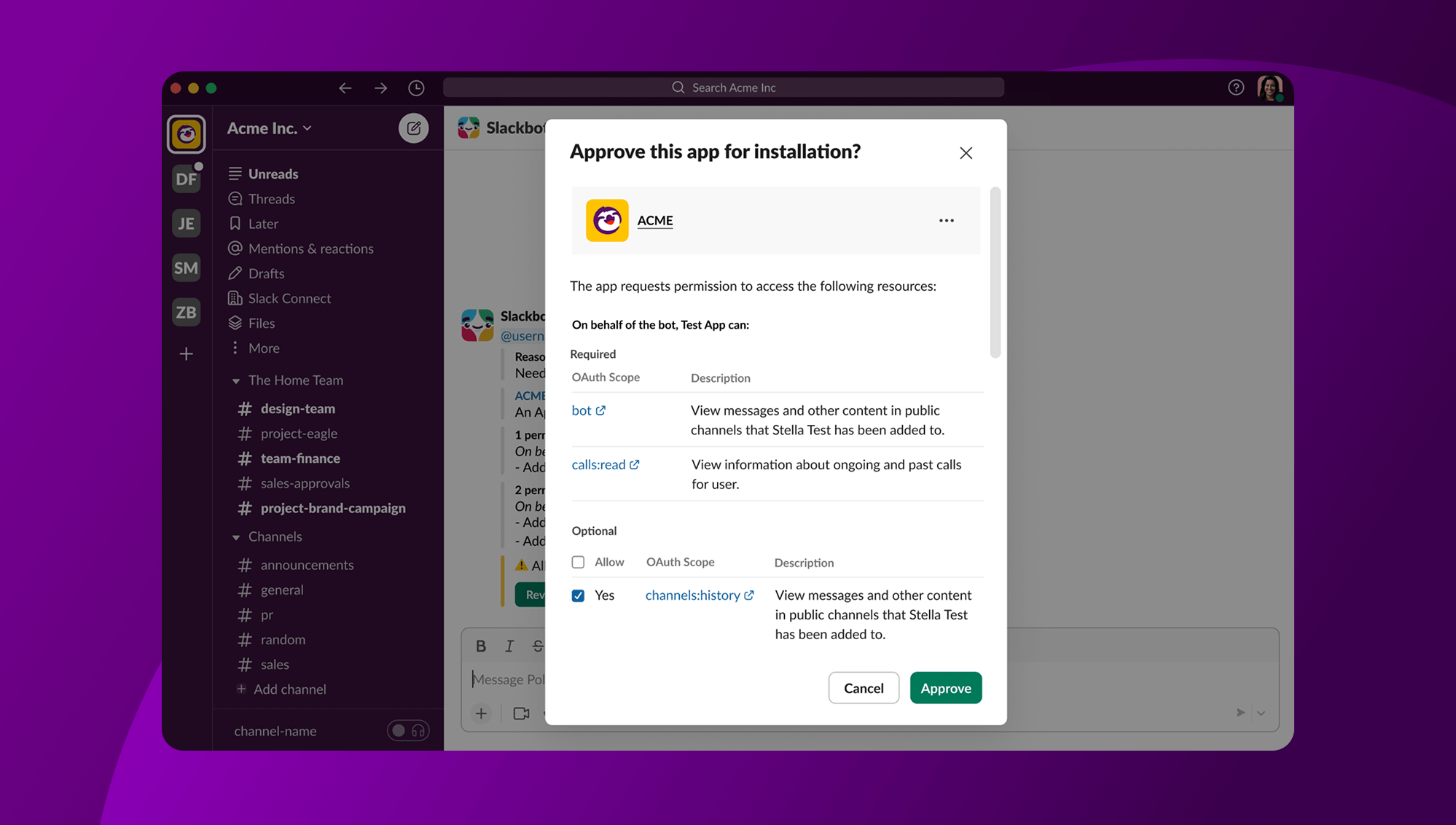
Instead of manually wiring each Slack API interaction into your application logic, MCP Server allows models to dynamically select and use Slack tools in real time. Authentication and permissions are handled automatically through Slack’s existing OAuth model, ensuring that every action respects the user’s access level.
This means less orchestration code, fewer custom integrations per agent, and a more scalable architecture for AI-powered apps.
Grounding agents with Real-time Search (RTS)
RTS provides secure, permission-aware access to Slack conversations, files, and threads as they exist in the workspace. Rather than exporting data or reconstructing context manually, your app can retrieve exactly what a user is authorized to see — at the moment it’s needed.
Together, RTS and MCP create a secure pipeline for context retrieval and tool execution. Agents can search, reason, and act within Slack’s native permission model, reducing both engineering effort and security risk.
What you can build
With this foundation in place, developers can focus less on plumbing and more on experience design.
You can build agents that summarize channel history and surface institutional knowledge. You can generate weekly updates grounded in active project conversations. You can draft incident communications that pull in relevant context automatically. You can monitor engineering discussions and update documentation as work evolves. The design space is expansive.
With user-scoped access and governance consistent with existing Slack apps, MCP fits seamlessly into enterprise security and compliance models.
The result is faster iteration, cleaner architecture, and more reliable agent behavior.
Get started
Slack MCP Server and Real-time Search API are available today.
Explore the RTS and MCP docs to start building, and experiment with integrating these new features into your existing Slack apps.
We’re excited to see what you build in this next era of agentic applications on Slack.